牠們被歸類成魚,是為了「讓大齋期也能吃」——目的就是原因
題目
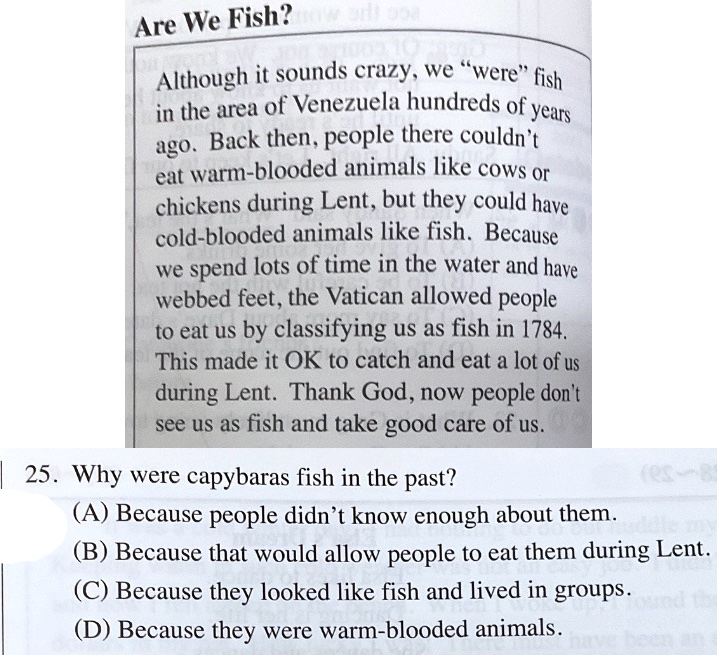
Although it sounds crazy, we “were” fish in the area of Venezuela hundreds of years ago. Back then, people there couldn’t eat warm-blooded animals like cows or chickens during Lent, but they could have cold-blooded animals like fish. Because we spend lots of time in the water and have webbed feet, the Vatican allowed people to eat us by classifying us as fish in 1784. This made it OK to catch and eat a lot of us during Lent. Thank God, now people don’t see us as fish and take good care of us.
(說話者是 capybara 水豚。Lent 大齋期/四旬期,天主教在復活節前的齋戒期間; warm-blooded 溫血的;cold-blooded 冷血的;webbed feet 蹼足;the Vatican 梵蒂岡;classify 分類)
Q25. Why were capybaras fish in the past?
- (A) Because people didn’t know enough about them.
- (B) Because that would allow people to eat them during Lent. ← 正確答案
- (C) Because they looked like fish and lived in groups.
- (D) Because they were warm-blooded animals.
這一題圖上只有紅筆訂正的 (B),沒有留下當時的作答, 所以下面直接講「怎麼把這條因果鏈接起來」。
這題的難點在哪裡
第一個 Because(文章寫的):
Because we spend lots of time in the water and have webbed feet… (因為我們常待在水裡、有蹼足……)
→ 這是「憑什麼可以說牠們像魚」的理由,是一個藉口、一個說法。
題目要的 Why(真正的目的):
the Vatican allowed people to eat us by classifying us as fish. This made it OK to catch and eat a lot of us during Lent.
→ 把牠們歸類成魚,是為了讓人在大齋期能吃。
兩者的差別是:
「有蹼、常泡水」是藉口(怎麼說得通); 「大齋期想吃肉」才是動機(為什麼要這樣說)。
選項 (C) 就是拿「藉口」來當答案的誘餌——而且還故意改錯了一半。
正確解法
| 大齋期(Lent) | 能不能吃 | 例子 |
|---|---|---|
| warm-blooded 溫血動物 | 不能吃 | 牛、雞 |
| cold-blooded 冷血動物 | 可以吃 | 魚 |
規則定死了:只有「魚」這類冷血動物在大齋期可以吃。
水豚其實是溫血的哺乳類——照規則不能吃。
那怎麼辦?把牠「歸類成魚」就可以了。
吃水豚 但 規定只能
吃魚 於是 把水豚
歸類成魚 結果 大齋期
就能吃了
文章最關鍵的一句是:
This made it OK to catch and eat a lot of us during Lent.
(這使得在大齋期大量捕食我們變成可以接受的事。)
「歸類成魚」這個動作的結果,就寫在這一句
——而題目問的 Why,答案就是這個結果所服務的目的。
→ (B) Because that would allow people to eat them during Lent.
- ✗(A) Because people didn’t know enough about them.
(因為人們對牠們了解不夠)
文章沒有這個意思。 把水豚歸類成魚不是「搞錯了」,而是刻意的安排 ——用 allowed、classifying 這些字,代表這是有意識的決定,不是無知。 - ✓(B) Because that would allow people to eat them during Lent.
直接對應 the Vatican allowed people to eat us by classifying us as fish
和 This made it OK to … eat a lot of us during Lent。
兩句都指向同一個目的:讓大齋期也吃得到。 - ✗(C) Because they looked like fish and lived in groups.
(因為牠們看起來像魚,而且群居)
兩半都有問題。
① 文章給的理由是 spend lots of time in the water(常待在水裡)和 have webbed feet(有蹼足),不是「看起來像魚」。
② lived in groups(群居)文章完全沒提到,是憑空加的。
而且就算改對了,這也只是「藉口」,不是「目的」。 - ✗(D) Because they were warm-blooded animals.
(因為牠們是溫血動物)
因果完全反了。 正因為牠們是溫血動物,照規定才不能吃 ——這是「問題」,不是「原因」。
要記住的觀念
- 問 Why 時,要分清楚「藉口」和「目的」。 文章裡的 Because 未必是題目要的答案—— 先問「這件事是為了達成什麼」。
- 看到「規定 + 例外」的文章,先畫出規則表。 能/不能兩欄列好,再看誰想繞過規則、怎麼繞。
- 因果題最愛把「問題」寫成「原因」。 (D) 就是——牠是溫血動物是「麻煩的來源」,不是「被歸類成魚的理由」。 代進去唸一次:「因為牠是溫血動物,所以被當成魚」——邏輯不通。
- 選項有兩個子句時,兩半都要查。 (C) 的前半錯(不是「看起來像」)、後半也錯(文章沒提群居)。 (第 1 冊 7/01 第 24 題的小貓那題也是敗在只看半句。)
- allow / make 的句型一起記:
allow + 人 + to V(允許某人做……)
make it OK to V(使得做……變成可以接受的)
by + V-ing = 藉由做…… (by classifying us as fish = 藉由把我們歸類成魚)
延伸:這篇文章的重點用法與觀點
這篇最特別的地方是「以水豚的第一人稱在說話」——
we、us、our 指的都是水豚。
看到文章用 we 卻在講動物,要先確認「這個 we 是誰」,
否則整篇都會讀錯。
題目問的是 capybaras,而文章從頭到尾沒出現 capybara 這個字
——這是靠題目回頭確認主角的典型設計。
classify A as B = 把 A 歸類為 B
see A as B = 把 A 視為 B
now people don’t see us as fish(現在人們不再把我們當成魚)
take good care of = 好好照顧
Back then = 在當時(= At that time)
Although it sounds crazy = 雖然聽起來很瘋狂
——這種開場白就是在預告「接下來要講一件違反直覺的事」。
還有一個時態值得注意:
we “were” fish——were 加了引號,
表示「所謂的『是』魚」,不是真的是魚,只是被當成魚。
引號在英文裡常有「所謂的、名義上的」這層意思,看到就要留意。
類題自我檢測
依照上面那篇文章判斷:
1. Which is true about capybaras?
(A) They are cold-blooded animals.
(B) They are still seen as fish today.
(C) They spend a lot of time in the water.
(D) People in Venezuela never ate them.
2. 為什麼水豚說 “Thank God”?
(A) 因為牠們終於被承認是魚。 (B) 因為現在人們不再把牠們當魚吃,還好好照顧牠們。
(C) 因為梵蒂岡取消了大齋期。 (D) 因為牠們可以自由地待在水裡。
看解答
1. (C)。文章寫 we spend lots of time in the water and have webbed feet。
(A) 錯:牠們是溫血動物(所以才需要被「歸類成」冷血的魚)。
(B) 錯:now people don’t see us as fish(現在不再把牠們當魚了)。
(D) 錯:文章明說 people there couldn’t eat warm-blooded animals … 但後來
This made it OK to catch and eat a lot of us。
2. (B)。最後一句:
Thank God, now people don’t see us as fish and take good care of us.
「不再被當成魚」= 不再被大量捕食,「好好照顧」= 現在的處境好多了。
(A) 剛好相反——被承認是魚對牠們是壞事,不是好事。
第 2 題提醒一件事:這篇文章的立場是「水豚的立場」。
對人類來說「可以吃了」是好消息,對水豚來說正好相反。
讀第一人稱的文章,一定要站在敘述者的角度判斷好壞。
我的原始作答
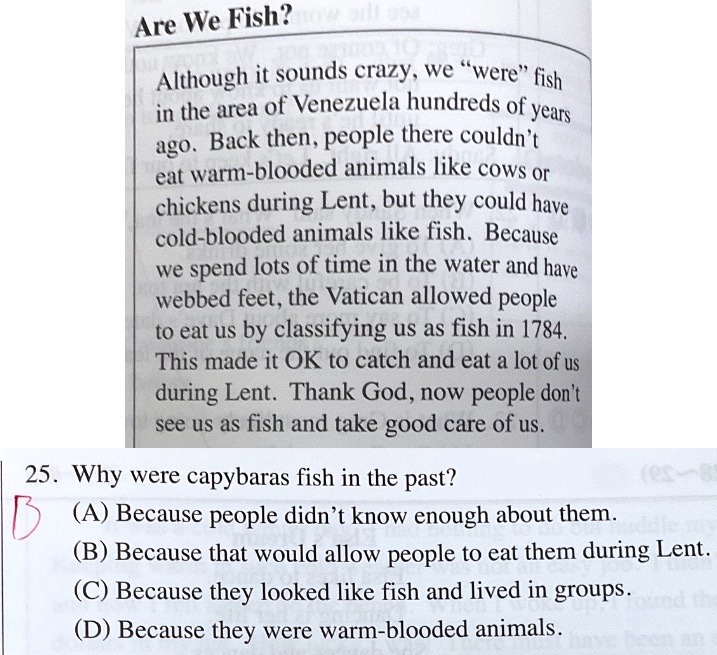
這一題圖上只有紅筆訂正的 (B),沒有留下當時選了什麼,所以不做作答分析。
這題的固定動作:問 Why 的時候,先在文章裡找出「誰做了什麼決定」
(這題是 the Vatican classified capybaras as fish)。
然後問:這個決定讓什麼事變成可能?
——答案就是那個「變成可能的事」。
複習標記
看完這一頁順手標一下,紀錄會同步到總覽頁—— 標「有把握」的會被劃掉,標「有疑問」的會被標成琥珀色,可以用「只看有疑問的」單獨叫出來。 再按一次同一顆按鈕就取消。紀錄存在這台裝置的瀏覽器裡。