猜字義要看「它在文章裡負責什麼工作」——ingredients 是材料,不是要買的東西
題目
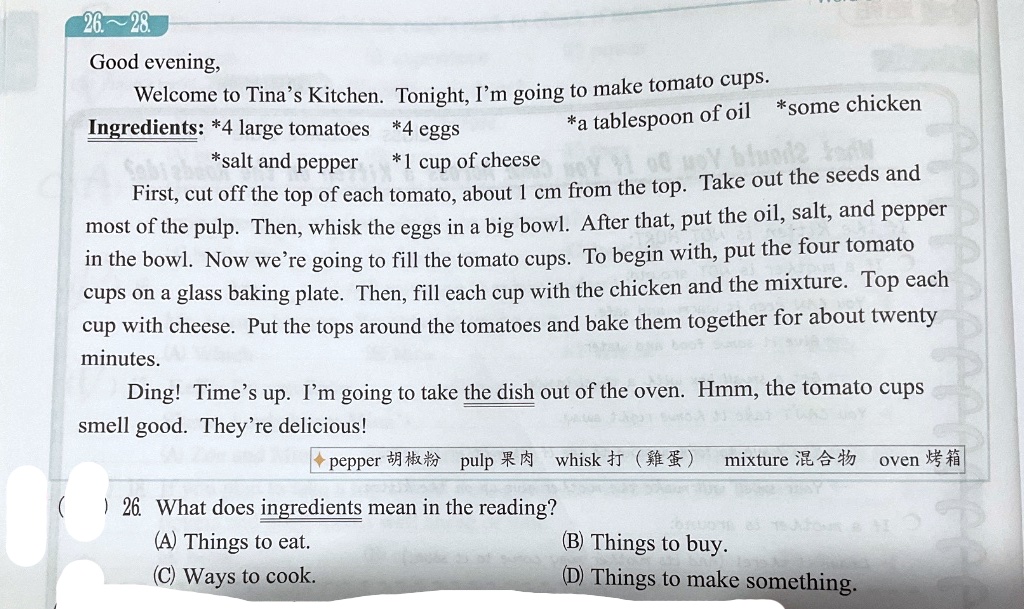
Welcome to Tina’s Kitchen. Tonight, I’m going to make tomato cups.
Ingredients: *4 large tomatoes *4 eggs *a tablespoon of oil *some chicken
*salt and pepper *1 cup of cheese
First, cut off the top of each tomato, about 1 cm from the top. Take out the seeds and most of the pulp. Then, whisk the eggs in a big bowl. After that, put the oil, salt, and pepper in the bowl. Now we’re going to fill the tomato cups. To begin with, put the four tomato cups on a glass baking plate. Then, fill each cup with the chicken and the mixture. Top each cup with cheese. Put the tops around the tomatoes and bake them together for about twenty minutes.
Ding! Time’s up. I’m going to take the dish out of the oven. Hmm, the tomato cups smell good. They’re delicious!
Q26. What does ingredients mean in the reading?
- (A) Things to eat.
- (B) Things to buy. ← 我的答案
- (C) Ways to cook.
- (D) Things to make something. ← 正確答案
錯在哪裡
「4 顆番茄、4 顆蛋、一大匙油、一些雞肉、鹽和胡椒、一杯起司」—— 這看起來很像去超市要買的東西,所以直覺選了 Things to buy。
但是回頭找證據就會發現:整篇文章一個 buy、shop、store、money 都沒有。
「要買」是自己腦補加上去的。
這些東西在文章裡真正的工作是——後面那一大段全部都在用它們做菜:
cut off the top of each tomato → whisk the eggs → put the oil, salt, and pepper → fill each cup with the chicken → top each cup with cheese。
清單上的每一樣東西,都在下一段被拿去「做成」tomato cups。 這就是 ingredients = 材料。
正確解法
(一串清單) + ②步驟
(First, Then, After that…)
文章裡 First / Then / After that / To begin with 這些字一路排下來,
那一段就是「步驟」。
而 Ingredients 這個標題底下是一串加了「*」的清單,前面還有數量(4 large、a tablespoon of、1 cup of)
——有數量的清單就是材料。
| 清單上的東西 | 在步驟裡的下場 |
|---|---|
| 4 large tomatoes | 被切開、挖掉籽,變成「杯子」 |
| 4 eggs | 被打散(whisk) |
| oil, salt and pepper | 加進蛋液裡 |
| some chicken | 填進番茄杯裡 |
| 1 cup of cheese | 鋪在最上面 |
| 結果 | 全部一起烤 20 分鐘 → the dish(成品) |
每一樣都被「用掉」,變成另一個東西。 被用來做出某個成品的東西,就叫「材料」→ (D) Things to make something。
- ✗(A) Things to eat.(可以吃的東西) 太寬,而且不精準。 oil、salt and pepper 不是拿來「吃」的,是拿來「調味、製作」的; 真正拿來吃的是最後那道 the dish。 如果 ingredients = 可以吃的東西,那成品也符合,這個定義就分不出材料和成品了。
- ✗(B) Things to buy.(要買的東西)
文章完全沒提到買。這是把「材料清單」和「購物清單」搞混。
同一串清單,寫在食譜裡叫材料,寫在冰箱門上才叫購物清單——要看它出現在哪裡。 - ✗(C) Ways to cook.(烹調方法)
方法是「動作」,不是「東西」。
文章裡的 cut、whisk、fill、top、bake 才是 ways to cook,
而那些字全都在 Ingredients 清單的「後面」,不在清單裡。
清單上一個動詞都沒有,所以不可能是方法。 - ✓(D) Things to make something.(用來做出某個東西的材料)
things(東西,不是動作)✓ to make something(拿來做出成品)✓
清單上的六樣東西最後全部變成 tomato cups,完全吻合。
要記住的觀念
- 字義推測題的判準是「功能」,不是「感覺」。 問自己:這個字後面接的東西,在文章裡被拿去做什麼?
- 先分辨選項是「東西」還是「動作」。 Things to… 是東西,Ways to… 是動作。 Ingredients 底下是名詞清單(沒有動詞)→ 一定是「東西」→ (C) 直接刪。
- 選項出現文章沒提過的概念(buy、money、school…),優先懷疑。 閱讀題的答案一定要在文章裡找得到根據,不能靠生活常識補。
- 認出文章體裁,答案會自己浮出來。 食譜=材料+步驟;說明書=零件+組裝;廣告=賣點+價格。 看到「標題+加點的清單+數量詞」,幾乎就是材料或零件。
- 太寬的選項也是錯的。 (A) Things to eat 不算完全離題,但它連成品也包進去了, 無法把 ingredients 和 the dish 分開 → 不夠精準就是錯。
延伸:這篇食譜的實用單字
a tablespoon of = 一大匙(teaspoon = 小匙、茶匙)
whisk = 打(蛋) mixture = 混合物 pulp = 果肉 oven = 烤箱
bake = 烘烤(用烤箱)/fry = 煎、炸/boil = water 煮沸
還有一組很好用的順序副詞,寫作文也用得到:
First → To begin with → Then → After that → Finally
這篇文章把它們排得很整齊,可以直接當作「說明流程」的作文模板背下來。
top 在這裡是動詞:top each cup with cheese = 在每個杯子上面鋪起司。
名詞的 top(頂端)在同一段也出現了(cut off the top of each tomato),
同一個字在同一段換了詞性,是閱讀題很愛考的點。
類題自我檢測
1. To build the model plane, you need these materials: paper, glue, and two small sticks.
What does materials mean?
(A) Things to sell. (B) Things to make something. (C) People who help you. (D) Steps to follow.
2. 承上題的判斷方式,如果文章寫的是
「Directions: First, cut the paper. Then, put the glue on it.」
那 Directions 最可能是什麼意思?
(A) 材料 (B) 價格 (C) 做法步驟 (D) 工具
看解答
1. (B) Things to make something。
paper、glue、sticks 都是被用掉、變成模型飛機的東西 → 材料。
判斷方式和 ingredients 完全一樣。
2. (C) 做法步驟。
底下接的是 First / Then + 動詞(cut、put)→ 是動作,不是東西。
兩題一起看就會發現:只要先問「底下是名詞清單還是動詞句子」,答案立刻分開。
名詞清單 → 材料;動詞句子 → 步驟。
我的原始作答
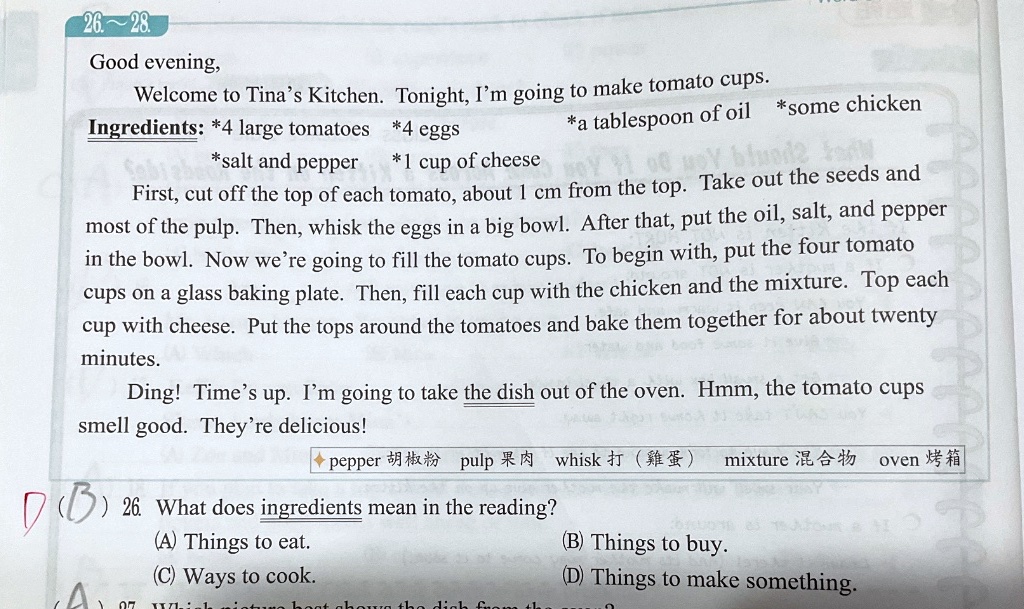
當時選了 (B) Things to buy,紅筆訂正為 (D) Things to make something。
(同一頁第 27 題選 (A) 是對的,沒有被訂正。)
這題的固定動作:看到畫底線的生字,先在文章裡把它「管轄的範圍」框起來——
這題的 Ingredients 管的是底下那六個「*」。
然後往下讀步驟,看框裡的東西最後變成了什麼。
複習標記
看完這一頁順手標一下,紀錄會同步到總覽頁—— 標「有把握」的會被劃掉,標「有疑問」的會被標成琥珀色,可以用「只看有疑問的」單獨叫出來。 再按一次同一顆按鈕就取消。紀錄存在這台裝置的瀏覽器裡。