主旨題看「篇幅最多的部分」,不看第一句——這封回覆有八成在逐點澄清
題目
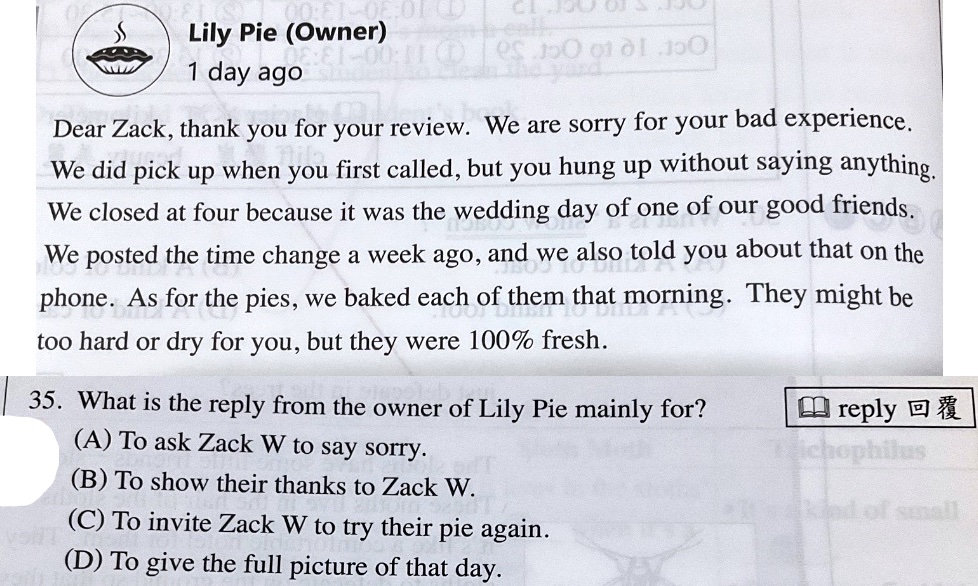
Dear Zack, thank you for your review. We are sorry for your bad experience.
① We did pick up when you first called, but you hung up without saying anything.
② We closed at four because it was the wedding day of one of our good friends. We posted the time change a week ago, and we also told you about that on the phone.
③ As for the pies, we baked each of them that morning. They might be too hard or dry for you, but they were 100% fresh.
(reply 回覆)
Q35. What is the reply from the owner of Lily Pie mainly for?
- (A) To ask Zack W to say sorry.
- (B) To show their thanks to Zack W.
- (C) To invite Zack W to try their pie again.
- (D) To give the full picture of that day. ← 正確答案
這一題圖上只有紅筆訂正的 (D),沒有留下當時的作答, 所以下面直接講「主旨題該怎麼判」。
這題的陷阱在哪裡
只讀第一句就作答,一定會選 (B) To show their thanks(表達謝意)。
但那只是客套的開場白,只佔一行。
整封信剩下的八成篇幅,全部都在做同一件事:把店家那一邊的說法補上。
主旨題(mainly for / mainly about / What is the purpose) 問的是「這篇文章花最多力氣在做什麼」, 不是「它的第一句話在做什麼」。
判斷方法很機械:把文章切段,數一數每一段在幹嘛,哪一類最多就是主旨。
正確解法
| # | 內容 | 在做什麼 | 篇幅 |
|---|---|---|---|
| 0 | thank you for your review. We are sorry for your bad experience. |
客套開場 | 1 行 |
| 1 | We did pick up when you first called, but you hung up without saying anything. | 澄清「沒接電話」 | 1 行 |
| 2 | We closed at four because it was the wedding day… We posted the time change a week ago, and we also told you on the phone. | 澄清「提早關門」 | 2 行 |
| 3 | As for the pies, we baked each of them that morning. They might be too hard or dry for you, but they were 100% fresh. | 澄清「派不新鮮」 | 2 行 |
五行裡有四行在澄清,只有一行是客套。
而且三段各對應 Zack 抱怨的一件事——這是有結構的逐點回應,不是隨口講講。
(提出事實) but 是因為 B
(說明原因) → 補上你不知道的那一半
We did pick up…, but you hung up.
(這裡的 did 是強調用法:我們「確實」有接電話。)
We closed at four because…(有原因)
They might be too hard…, but they were 100% fresh.
(承認口感,但澄清新鮮度)
三段都是「承認表面現象 + 補上背後的事實」。
這正是「give the full picture(呈現全貌)」的定義。
- ✗(A) To ask Zack W to say sorry.(要求 Zack 道歉)
信裡完全沒有要求對方道歉,反而是店家先說 We are sorry。
語氣也不對:整封信是解釋,不是反擊。 - ✗(B) To show their thanks to Zack W.(表達謝意)
thank you 只有第一句,佔一行。
如果主旨是道謝,後面那四行的解釋就沒有理由存在。
這是「只讀開頭就作答」的典型陷阱—— 商業回覆幾乎都以道謝開場,那是禮貌,不是目的。 - ✗(C) To invite Zack W to try their pie again.(邀他再來吃)
信裡沒有任何邀請——沒有 come back、no discount、no next time。
這是憑「店家通常會這樣做」的常識腦補出來的,文章沒寫就是沒有。 - ✓(D) To give the full picture of that day.(說明那天的完整經過)
三段分別補上了電話、營業時間、派的三件事的另一面,
讓讀者看到「Zack 沒看到的那一半」。
full picture = 完整的樣貌,正好概括這封信的四行主體。
要記住的觀念
- 主旨題=數篇幅,不是讀第一句。 把文章切成幾塊,每塊用三個字標註它在做什麼,最多的那一類就是主旨。
- 開場的客套話不是主旨。 Thank you for… / We are sorry for… / I hope you are well 都是禮貌用語,出題者最愛拿它們當誘餌。
- 「文章沒寫」的選項一律刪。 (C) 的「邀請再來」很符合常理,但信裡一個字都沒提。 閱讀題的證據只能來自文章。
- 看到 but、because、did + 原形動詞,代表作者在「爭取自己的說法」。 整篇都是這種句型 → 主旨幾乎一定是「解釋/澄清」。
- 回覆型文章要先想「他在回應誰的什麼」。 三段各對應一項抱怨—— 看得出這個對應關係,答案就出來了。
延伸:這封信裡的重點用法
① 強調用的 do / does / did
We did pick up = 我們「確實」有接電話(不是「我們做接電話」)。
助動詞 do 放在肯定句裡,就是用來反駁對方「你根本沒接」。
I do like it.(我真的喜歡。) He does know the answer.(他確實知道答案。)
注意:do/does/did 後面一定接原形動詞(did pick,不是 did picked)。
② hang up = 掛電話(hang-hung-hung)
pick up = 接電話(也可以是「撿起、接送」)
③ As for = 至於(換一個話題)
As for the pies, …(至於派的部分,……)
這個片語就是在告訴讀者「我要開始講第三件事了」——是分段的訊號詞。
④ might = 可能(語氣比 may 更保留)
They might be too hard or dry for you = 對你來說可能太硬或太乾
——用 might 和 for you,把責任講得很客氣,但沒有承認派有問題。
這種「客氣但不認錯」的語氣,正好證明整封信的目的是澄清。
類題自我檢測
Dear Ms. Chen,
Thank you for your letter. I am glad you like our magazine.
About the mistake on page 12, you are right — the date should be June 5, not June 15.
We also checked pages 20 and 33, and found two more mistakes there.
We will put the correct information on our website this Friday.
Q: What is this letter mainly for?
(A) To thank Ms. Chen for buying the magazine.
(B) To tell Ms. Chen how the magazine is made.
(C) To answer the mistakes Ms. Chen pointed out and tell what they will do.
(D) To ask Ms. Chen to visit their website every Friday.
看解答
(C)。判斷方式和本題一模一樣:
Thank you for your letter 只有一句(客套),
後面四行全部在講「錯誤在哪裡、還查到什麼、要怎麼處理」。
(A) 是被開場的 Thank you 騙了——而且信裡根本沒說她「買」了雜誌。
(B) 文章沒提到雜誌怎麼製作。
(D) 提到 website 和 Friday,但那是「他們會做的事」,不是「要求她每週去看」——
把文章裡的字重新組合成一個文章沒說的意思,是很常見的誘餌手法。
再記一次:主旨題先數篇幅,開場的道謝一律不算。
我的原始作答
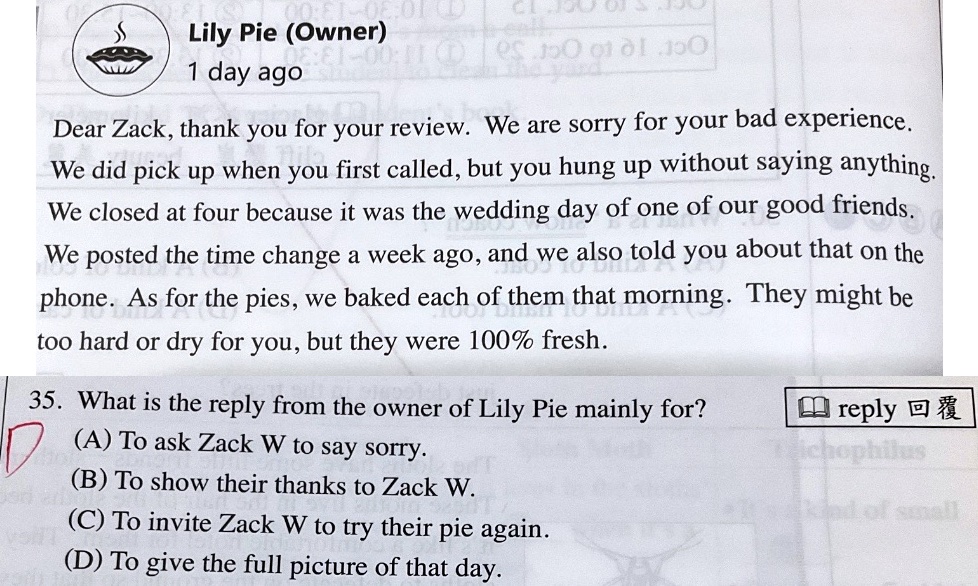
這一題圖上只有紅筆訂正的 (D),沒有留下當時選了什麼,所以不做作答分析。
這題的固定動作:看到 mainly for/mainly about,先在文章每一段旁邊用中文寫三個字
(道謝/解釋/邀請/說明做法)。
寫完數一數哪一種最多,答案就是它——不要被第一句的客套話帶走。
複習標記
看完這一頁順手標一下,紀錄會同步到總覽頁—— 標「有把握」的會被劃掉,標「有疑問」的會被標成琥珀色,可以用「只看有疑問的」單獨叫出來。 再按一次同一顆按鈕就取消。紀錄存在這台裝置的瀏覽器裡。